NexaGPU NexaGPU

Best Cloud AI Server Manufacturer in China?

Time:2026-09-20 Author:Oliver
0%

Choosing the best cloud ai server manufacturer in China requires more than comparing processor counts or factory photos. The real test begins inside the rack. Can the platform sustain high GPU utilization, stable networking, and predictable cooling under continuous workloads?

TrendForce reported that global AI server shipments were expected to grow by about 28% year over year in 2024. IDC’s Worldwide Artificial Intelligence and Generative AI Spending Guide also identifies infrastructure as a major investment area. These findings show strong demand, but they do not prove that every supplier can deliver enterprise-grade systems.

Jensen Huang, NVIDIA’s founder and CEO, has said, “The future of computing is accelerated computing.” His statement reflects the market’s direction. Modern cloud AI servers need more than powerful GPUs. They require validated GPU platforms, high-speed interconnects, efficient liquid or air cooling, redundant power, and disciplined firmware management.

A capable cloud ai server manufacturer should provide clear benchmark conditions, including model size, batch settings, thermal limits, and network topology. It should also explain lead times, warranty coverage, spare-parts access, and remote diagnostics. These details matter when a failed server can interrupt training for hours.

China offers strong manufacturing depth and a broad component ecosystem. However, “best” remains relative. A low purchase price may hide higher energy use or weaker support. That is the uncomfortable part. Buyers should verify claims through factory audits, reference customers, and independent testing. No ranking is perfect, but transparent evidence creates a more reliable decision.
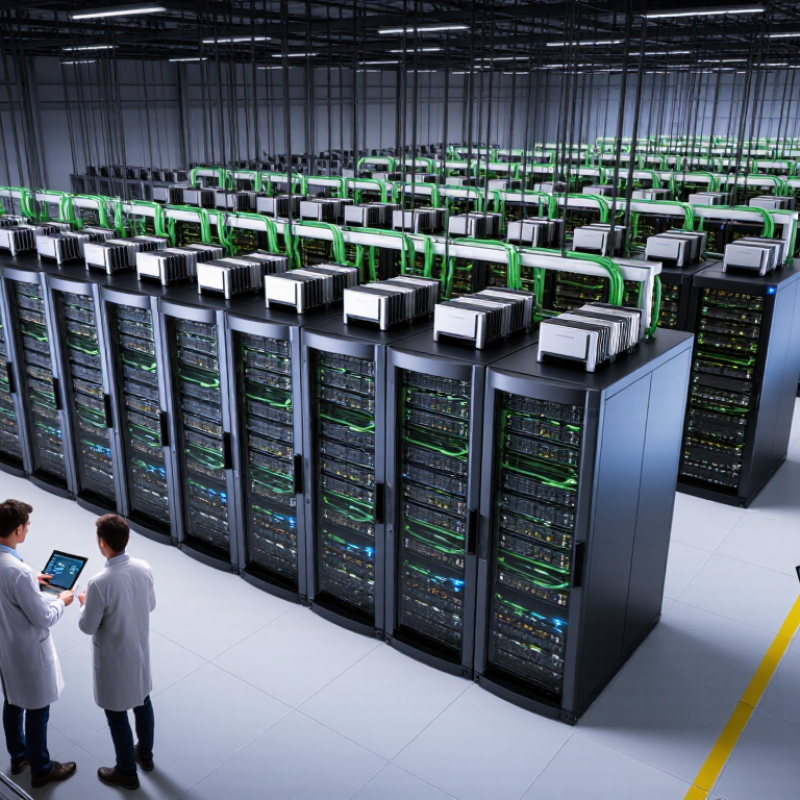
Best Cloud AI Server Manufacturer in China?

What Defines a Leading Cloud AI Server Manufacturer in China?

A leading cloud AI server manufacturer in China is defined by measurable engineering, not polished marketing. It should design systems for dense GPU workloads, fast interconnects, and sustained utilization. The IEA’s Energy and AI report estimates that data centers consumed about 415 TWh of electricity worldwide in 2024. Demand could more than double by 2030. Therefore, efficient power delivery and liquid-cooling readiness are now core manufacturing capabilities, not optional features.

Reliability must be proven under pressure. Buyers should examine thermal test records, component traceability, firmware controls, and failure-replacement procedures. The Uptime Institute’s Global Data Center Survey repeatedly identifies power and cooling as major operational risks. A capable manufacturer should support redundant power paths, hot-swappable components, and remote diagnostics. It should also publish realistic performance results. Numbers matter. Peak benchmark scores alone can mislead.

China’s strongest cloud AI server manufacturers combine local production depth with global engineering discipline. They should validate servers against recognized safety, electromagnetic compatibility, and information-security requirements. Supply-chain resilience matters too, especially for memory, networking devices, and advanced accelerators. The Stanford AI Index 2025 reports that AI hardware and infrastructure costs remain significant barriers to deployment. This makes lifecycle cost more important than purchase price. Service teams need practical experience with cluster failures at night, not only showroom demonstrations. I would still question any supplier promising perfect availability; complex AI infrastructure always exposes weaknesses. The better choice is a manufacturer that documents them, measures recovery time, and improves openly.

China’s Major Cloud AI Server Manufacturers and Their Core Strengths

China’s leading cloud AI server manufacturers usually fall into three groups: established computing hardware makers, cloud infrastructure divisions, and large ODM suppliers. Each group serves a different operating model. Hardware specialists often provide strong rack-scale designs, dense GPU configurations, and mature maintenance systems. Cloud-focused manufacturers understand workload scheduling better. ODM suppliers usually compete through flexible customization and efficient production.

Their core strengths are practical. Many support eight or more accelerator cards in a single server, depending on thermal and power limits. High-speed networking helps move training data between nodes with less delay. Liquid cooling is becoming more common in dense deployments, especially where air cooling struggles. Domestic supply chains can also shorten delivery times for standard components. However, availability does not always mean consistency. Firmware quality, driver compatibility, and long-term spare-part support still require careful testing.

From an engineering perspective, buyers should request benchmark results using their own models. A server that performs well in a laboratory may behave differently under continuous inference traffic. Site visits can reveal cable layouts, noise levels, cooling access, and maintenance habits. Certifications and documented security controls also matter for regulated workloads. Some manufacturers explain these areas clearly; others provide impressive specifications but limited field evidence. That gap deserves attention. In my experience, the strongest supplier is not always the one with the fastest accelerator count. It is the one that can keep systems stable at three in the morning.

Best Cloud AI Server Manufacturer in China?

China’s computing infrastructure growth creates four core strength areas for cloud AI server manufacturers: scalable AI capacity, hyperscale integration, supply-chain coordination, and energy-efficient deployment.

The chart uses publicly reported national computing-power figures: approximately 180 EFLOPS in 2022, 230 EFLOPS in 2023, and 280 EFLOPS in 2024. The 2025 value represents China’s publicly stated national development target of more than 300 EFLOPS. These figures describe market infrastructure demand rather than the performance of any individual company or brand.

Key Technologies Used in Cloud AI Server Manufacturing

Best Cloud AI Server Manufacturer in China?

A strong cloud AI server manufacturer in China is defined by engineering depth, not a polished catalogue. Modern systems combine high-density GPUs, advanced CPUs, fast memory, and low-latency networking. GPU interconnects allow multiple accelerators to share workloads efficiently. This matters during model training, where small delays can become expensive over many hours. Reliable manufacturers also design power delivery systems for heavy, continuous loads. Liquid cooling is increasingly valuable in compact racks. It removes heat more evenly than traditional airflow. Some facilities still depend on air cooling, but that choice can limit future performance.

Manufacturing quality depends on more than assembly. Engineers validate circuit layouts, firmware stability, thermal paths, and rack-level airflow. Remote management tools can monitor temperature, fan speed, power use, and component errors. Secure boot and controlled firmware updates help protect cloud infrastructure. High-speed Ethernet or specialized fabric technology supports distributed inference and training. In practice, I would request test records, burn-in results, and failure-rate data before making a purchasing decision. Specifications can look impressive. Real workload testing is more revealing. No design is perfect, and cooling assumptions sometimes need revision after deployment.

Tips: Ask for workload-based benchmarks, not only peak performance. Check service response times and spare-parts availability. Confirm compatibility with your preferred operating systems and orchestration tools. A useful evaluation should include noise, power consumption, maintenance access, and three-year operating costs. The cheapest server may become expensive when energy and downtime are included.

How to Compare Chinese Cloud AI Server Manufacturers

Comparing Chinese cloud AI server manufacturers requires more than checking GPU availability. IDC reported that global AI infrastructure spending reached about $154 billion in 2024. This growth increases pressure on delivery, cooling, and system reliability. Ask manufacturers for audited production capacity, component traceability, and recent deployment evidence. A polished showroom means little without maintenance records.

Evaluate server design at the rack level. Check GPU compatibility, high-speed networking, power distribution, liquid-cooling options, and firmware update procedures. The Uptime Institute repeatedly identifies power and cooling as major data-center risks. Therefore, request measured performance under sustained workloads, not only short benchmark results. MLCommons benchmark data can help, but results may vary with software versions and configuration.

Total cost needs a wider lens. Include electricity, cooling water, replacement parts, technical support, and migration labor. TrendForce has forecast strong annual growth in AI server shipments, yet supply growth does not guarantee dependable service. Compare warranty response times, spare-part locations, engineer coverage, and security documentation. Request customer references with similar workloads. A spreadsheet can still mislead. I would also test one small cluster before signing a large contract; this step is slower, but it exposes integration problems early. Manufacturers should explain failed tests honestly, although not every sales team will.

Selecting the Best Manufacturer for Different Cloud AI Workloads

Best Cloud AI Server Manufacturer in China?

Selecting the Best Manufacturer for Different Cloud AI Workloads

Choosing a Chinese cloud AI server manufacturer requires workload evidence, not attractive specifications. Training large models needs dense accelerator nodes, high-speed interconnects, and stable liquid cooling. Inference workloads need predictable latency, flexible memory, and efficient power use. IDC’s Worldwide AI and Generative AI Spending Guide forecasts global AI infrastructure spending will reach about $632 billion by 2028. That growth makes scalable design essential.

Ask manufacturers for tested results under your actual workload. Request tokens per second, training time, network latency, and power consumption at sustained utilization. A prototype running for two hours proves little. A seven-day stress test reveals thermal throttling, software faults, and maintenance weaknesses. The IEA’s Electricity 2024 report estimates data-center electricity demand could exceed 1,000 TWh annually by 2026. Energy efficiency is therefore a financial requirement, not a marketing detail.

Review rack density, cooling redundancy, firmware control, spare-part availability, and local technical support. Confirm compatibility with your preferred orchestration, storage, and virtualization systems. Security documentation should cover access control, update procedures, and supply-chain traceability. Service-level commitments also matter during peak demand. Numbers can mislead. A lower purchase price may hide higher cooling and downtime costs. I would also challenge every forecast; real workloads often behave differently from laboratory benchmarks. Choose the manufacturer that measures openly, explains limitations, and improves after failure.

Best Cloud AI Server Manufacturer in China? - Selecting the Best Manufacturer for Different Cloud AI Workloads
Cloud AI Workload Typical Workload Profile Recommended Server Configuration Key Performance Requirements Manufacturer Selection Criteria Recommended Acceptance Tests
Large-Scale Model Training Distributed training of large language, vision, or multimodal models using synchronized data-parallel or tensor-parallel workloads. 8 accelerators per node High-memory accelerator options Dual-socket CPU 512 GB–2 TB system memory High accelerator-to-accelerator bandwidth, low-latency node-to-node networking, sustained power delivery, and stable operation under continuous full-load conditions. Proven multi-node topology design, validated accelerator compatibility, efficient liquid or high-capacity air cooling, redundant power supplies, and strong firmware management capabilities. Measure sustained training throughput, scaling efficiency from 1 to 8 or more nodes, network collective-operation performance, GPU error rates, and thermal stability during a 24–72 hour stress test.
Fine-Tuning and Retrieval-Augmented Generation Parameter-efficient fine-tuning, embedding generation, vector indexing, and retrieval-assisted inference for enterprise knowledge bases. 4–8 accelerators 256 GB–1 TB system memory High-capacity NVMe 25/100 GbE networking Adequate accelerator memory, fast dataset loading, high random-read performance, low latency for vector search, and flexible support for mixed precision. Modular configurations, simple accelerator expansion, support for multiple storage layouts, validated container environments, and convenient remote administration. Test fine-tuning time per epoch, document-ingestion throughput, vector-search queries per second, p95 retrieval latency, and recovery after storage or node restart.
Real-Time LLM Inference Interactive text generation, conversational AI, customer-service automation, and API-based model serving with strict response-time targets. 1–4 accelerators Large accelerator memory High-core-count CPU 25/100 GbE Low time-to-first-token, consistent inter-token latency, high concurrent-request capacity, rapid model loading, and predictable performance under burst traffic. Strong thermal control at low latency, flexible partitioning or virtualization, reliable network adapters, remote lifecycle management, and fast replacement support. Record time-to-first-token, tokens per second, p95 and p99 latency, concurrent-user capacity, power consumption per request, and service behavior during traffic spikes.
Batch Inference and Video Analytics Large-scale image classification, object detection, OCR, video transcoding, and offline processing of high-volume media datasets. 2–8 accelerators High-throughput NVMe or storage network 10/25/100 GbE Optional local scratch storage High data-ingestion bandwidth, efficient pipeline utilization, parallel storage access, and predictable throughput for long-running scheduled jobs. Balanced CPU, accelerator, and storage design; strong airflow management; support for dense storage configurations; and validated media-processing software stacks. Measure images or video frames processed per second, accelerator utilization, storage throughput, job completion time, and performance degradation at maximum density.
Scientific and Engineering AI Simulation-assisted machine learning, computational fluid dynamics, molecular modeling, digital twins, and high-performance numerical workloads. High-core-count CPUs 4–8 accelerators ECC memory 200/400 Gb/s fabric options High floating-point performance, memory bandwidth, reliable parallel file access, low-latency collective communication, and error detection for long computations. Capability to validate HPC interconnects, NUMA topology, accelerator affinity, ECC memory operation, BIOS tuning, and workload-specific benchmark optimization. Run representative HPC benchmarks, evaluate weak and strong scaling, verify ECC error reporting, measure checkpoint time, and confirm stable operation under extended load.
Cloud AI Development and MLOps Model experimentation, notebook environments, data preparation, continuous integration, model evaluation, and shared development workloads. 1–4 accelerators 128–512 GB system memory Redundant boot drives 10/25 GbE Flexible resource allocation, fast environment deployment, reliable storage, secure remote access, and efficient operation across mixed workloads. Support for virtualization or container orchestration, secure boot options, out-of-band management, clear firmware update procedures, and long-term parts availability. Test virtual-machine or container startup time, resource isolation, image deployment speed, management-controller responsiveness, firmware rollback, and backup restoration.
Private Cloud and Multi-Tenant AI Shared infrastructure serving multiple teams or customers with isolated quotas, workload scheduling, and service-level performance targets. Mixed accelerator types Redundant networking Distributed storage support Cluster-scale management Strong workload isolation, predictable performance, high availability, flexible scheduling, and centralized health monitoring across the cluster. Validated cluster reference architectures, complete management APIs, secure tenant isolation, hot-serviceability where applicable, and documented escalation procedures. Verify tenant isolation, quota enforcement, failover behavior, noisy-neighbor impact, rolling maintenance, node replacement time, and cluster monitoring accuracy.
Edge AI and Regional Cloud Deployment AI inference close to users, industrial sites, retail locations, transportation systems, or regions with limited data-center infrastructure. 1–4 compact accelerators Short-depth or rugged chassis 10/25 GbE Optional extended-temperature design Compact physical design, low power consumption, rapid boot and recovery, reliable operation in variable environments, and secure remote administration. Experience with ruggedization, acoustic and thermal constraints, regional service coverage, remote diagnostics, secure firmware, and simplified field replacement. Test performance at rated temperature and humidity ranges, boot recovery after power interruption, remote management, network reconnection, and power consumption under representative inference loads.
High-Availability AI Services Business-critical AI APIs, fraud detection, recommendation systems, healthcare analytics, and other services requiring continuous availability. Redundant power supplies Mirrored boot storage Dual network paths Cluster failover design Fast failure detection, graceful workload migration, predictable recovery time, component monitoring, and minimal performance loss during maintenance. Mature reliability engineering, hot-plug component support where appropriate, detailed failure logs, spare-parts planning, documented RMA procedures, and integration with enterprise monitoring systems. Perform power-supply, fan, drive, network, and node-failure simulations; measure failover time, data integrity, service recovery, and performance after component replacement.
Reference values are typical engineering ranges rather than universal specifications. Final selection should be based on the target model, software stack, data-center power and cooling limits, network architecture, service-level objectives, and validated benchmark results.

FAQS

What defines a leading cloud AI server manufacturer in China?

Measurable engineering defines leadership, not polished marketing. The manufacturer should support dense accelerators, fast interconnects, and sustained utilization. Peak scores alone mislead.

Why are power delivery and cooling important for cloud AI servers?

AI workloads create heavy, continuous heat inside crowded racks. Efficient power delivery and liquid-cooling readiness reduce throttling and operating costs. Cooling failures can stop an entire cluster.

How can buyers evaluate server reliability?

Request thermal records, component traceability, firmware controls, and replacement procedures. Check redundant power paths and hot-swappable parts. Ask how failures are diagnosed remotely.

Which workloads need different server designs?

Model training needs dense accelerators, fast networking, and stable cooling. Inference needs predictable latency, flexible memory, and efficient power use. One design rarely suits everything.

What performance tests should manufacturers provide?

Request results from your own models and data patterns. Measure tokens per second, training time, latency, and power consumption. A seven-day stress test reveals more than a two-hour demonstration.

How many accelerator cards can one server support?

Some systems support eight or more accelerator cards, depending on power and thermal limits. Card count is not enough. Network speed and cooling access also matter.

Why does lifecycle cost matter more than purchase price?

Energy, cooling, spare parts, and downtime can exceed the initial price difference. Data-center electricity demand is rising sharply. A cheaper server may become expensive every night.

What support should a cloud AI server manufacturer provide?

Service teams should handle cluster failures during off-hours, not only showroom demonstrations. Review response times, recovery records, and spare-part availability. Perfect availability sounds doubtful.

How should buyers assess security and compatibility?

Confirm access controls, update procedures, firmware governance, and supply-chain traceability. Test compatibility with orchestration, storage, and virtualization systems. Documentation may be incomplete, so ask uncomfortable questions.

Conclusion

Choosing the best cloud ai server manufacturer in China requires more than comparing hardware specifications or production capacity. A leading manufacturer should combine reliable engineering, scalable production, strong quality control, efficient customization, and responsive technical support. China’s manufacturing ecosystem offers different strengths, including advanced computing integration, flexible configuration, energy-conscious design, and solutions adapted to data centers, research institutions, enterprise AI, and edge-oriented deployments.

Key technologies may include GPU and accelerator integration, high-speed interconnects, liquid or advanced air cooling, intelligent power management, virtualization support, and secure remote monitoring. Buyers should compare performance, compatibility, delivery capability, service coverage, lifecycle costs, and the manufacturer’s ability to handle demanding workloads such as model training, inference, analytics, and scientific computing. The most suitable supplier will depend on workload intensity, budget, deployment scale, energy limits, and future expansion plans. A careful evaluation of both technical capabilities and long-term support can help organizations select a dependable manufacturing partner.

Oliver

Oliver

Oliver is a seasoned marketing professional with a wealth of expertise in driving brand awareness and engagement. With a deep understanding of our company's product offerings, he consistently delivers high-quality content that enriches our professional blog. His insights not only shed light on......